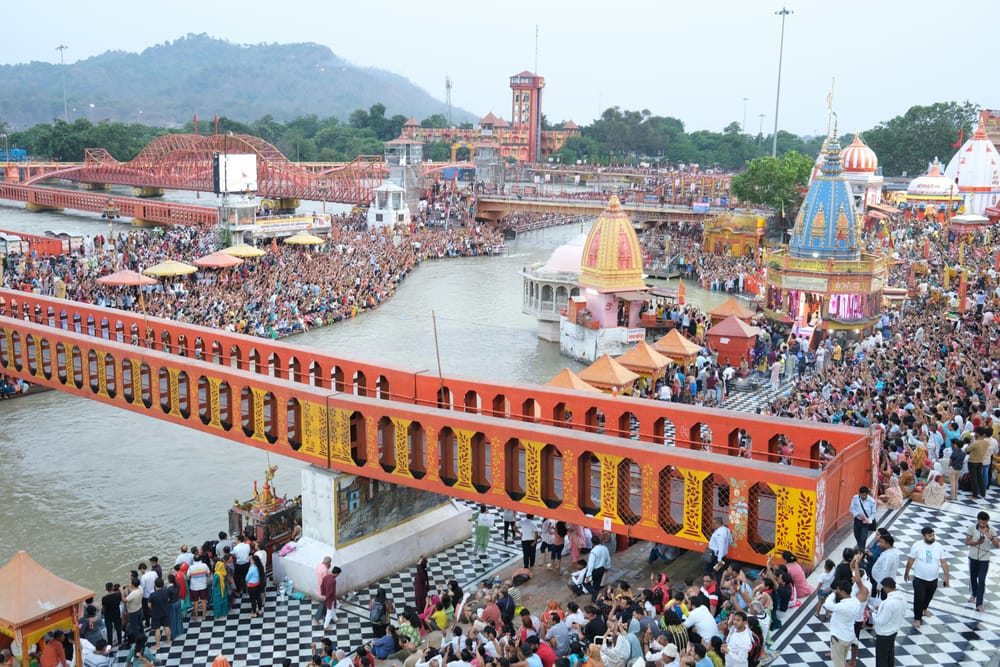

Haridwar - the name itself translates to "Gateway to God" - and few cities in India carry that weight as honestly as this one. Sitting where the sacred Ganga River descends from the Himalayas and first touches the plains of Uttarakhand, Haridwar is one of the seven holiest cities in Hindu tradition. It is a city of flaming diyas floating on dark water, of Sanskrit chants bouncing off stone ghats, of pilgrims arriving from every corner of India with copper pots in hand. But it is also a city of chaotic markets, street food that smells like heaven, ancient caves, quiet ashrams, and wildlife reserves hidden behind the spiritual buzz.
Whether you are coming as a pilgrim, a curious traveller, a wellness seeker, or simply someone who wants to witness one of the most visually stunning evenings on earth - the Ganga Aarti at Har Ki Pauri - this guide covers everything you need to know before you go.
1. How to Reach Haridwar
By Road: Haridwar is extremely well connected by road and sits on NH 58. From Delhi it is about 214 km, which translates to a 5-6 hour drive depending on traffic. Buses from Delhi's Kashmere Gate ISBT run frequently and are affordable. From Dehradun it is around 54 km (about an hour), and from Rishikesh just 24 km. If you are self-driving or hiring a cab from Delhi, the Haridwar-Delhi highway is smooth and straightforward.
By Train: Haridwar Junction is a major railway station on the Northern Railway zone and has direct train connections to Delhi, Mumbai, Kolkata, Jaipur, Varanasi, Amritsar, and most other major cities. Popular trains include the Shatabdi Express and the Jan Shatabdi from Delhi, which make the journey in under 4.5 hours. This is the most convenient and commonly used mode of arrival.
By Air: Haridwar does not have its own airport. The nearest is Jolly Grant Airport in Dehradun, around 38 km away (roughly 1 hour by road). Several daily flights connect Dehradun to Delhi, Mumbai, and Bengaluru. From the airport, taxis and shared cabs to Haridwar are easily available. For international travellers, Indira Gandhi International Airport in Delhi is the primary entry point, followed by a train or road journey to Haridwar.
By Air from Mumbai (relevant for Maharashtra travellers): The easiest route is to fly into Delhi or Dehradun, then take a train or cab to Haridwar. The entire journey including travel time is typically done in a single day.
Best Time to Visit: October to February is ideal for sightseeing and pleasant walking weather. March to June is warm but manageable, and the festivals of Kumbh and Kanwar Mela attract massive crowds in their respective years. July to September brings the monsoon and fewer tourists - a good time if you prefer quieter ghats.
2. Famous Places to Visit
These are the essential Haridwar experiences, the ones that give the city its identity:
Har Ki Pauri The spiritual heart of Haridwar and arguably the most sacred bathing ghat in all of North India. The central section called Brahmakund is believed to be the exact spot where the Ganga touched the plains, and bathing here is said to wash away all sins and grant moksha. The ghat is lined with temples, priests, flower sellers, and diya stalls, and the steps descend dramatically to the fast-flowing river. Do not miss it on a quiet early morning - the contrast with the evening scene is remarkable.
Ganga Aarti at Har Ki Pauri Every evening at sunset, Har Ki Pauri transforms into one of the most hypnotic sights in India. Priests dressed in saffron perform a synchronized aarti with massive flaming torches while bells ring, conches blow, and thousands of devotees float small diyas on the river. The entire ghat glows orange and gold. If you see only one thing in Haridwar, this should be it. Arrive at least 45 minutes early to secure a good spot.
Mansa Devi Temple Perched atop Bilwa Parvat hill, this temple dedicated to Goddess Mansa Devi is one of Haridwar's Panch Tirth (five holy pilgrimages). A ropeway (Udan Khatola) carries visitors up, offering sweeping views of the city and the Ganga below. The hilltop also gives you one of the best aerial views of Haridwar you will find.
Chandi Devi Temple Located on Neel Parvat, this temple dedicated to Goddess Chandi is another of the five tirthas of Haridwar. Reachable by ropeway or a 3 km trek, it is believed the goddess defeated the demon generals Chanda and Munda here. A visit to both Mansa Devi and Chandi Devi together makes for a full and meaningful morning.
Maya Devi Temple One of the oldest temples in Haridwar and another of the Panch Tirth, this 11th-century structure is dedicated to Goddess Maya, the presiding deity of Haridwar. It is quieter than the hilltop temples and rewards those who take the time to visit.
Bharat Mata Mandir An eight-story temple that is unique in all of India - it is not dedicated to a deity but to Mother India herself. Each floor represents a different aspect of Indian culture, geography, and heroism, with detailed murals and maps across the levels. A fascinating, non-religious visit that works well for all travellers.
Rajaji National Park On the edge of Haridwar, this national park is home to elephants, leopards, tigers, deer, and over 300 species of birds. Morning jeep safaris into the Chilla Range are popular and can be booked in advance. It is a side of Haridwar that many first-time visitors overlook entirely.
Shantikunj Ashram A major spiritual campus founded by the All World Gayatri Pariwar, offering free yoga and meditation sessions, Vedic lifestyle programs, and a genuinely calming environment. Well worth a morning visit even for non-religious travellers.
Bhimgoda Tank A short walk from Har Ki Pauri, this kund (tank) is believed to have been created when Bhim struck the ground with his knee during the Pandavas' journey through Haridwar. A peaceful and historically significant spot that rarely feels crowded.
3. Hidden & Offbeat Places
Haridwar rewards those who stray beyond the main ghat and its surrounding temples:
Neel Dhara Pakshi Vihar (Bird Sanctuary) Located at Bhimgoda Barrage, this quiet bird sanctuary offers excellent birdwatching with the Shivalik hills as a backdrop. It draws migratory birds seasonally and is perfect for anyone travelling with binoculars or a long-lens camera. Very few tourists make it here, which is exactly the point.
Saptarishi Ashram About 4 km from the main ghat, this ashram sits on the banks of the Ganga at a point where the river famously splits into seven streams - believed to be where the seven great sages (saptarishis) once meditated. The surroundings are extraordinarily peaceful and the views of the clear Ganga channels are unlike anything you see at the busy ghats. Some travellers stay here in modest cottages at minimal cost to experience slow, riverside life.
Daksh Prajapati Temple, Kankhal Located in the Kankhal district just outside the main city, this ancient temple complex holds deep significance in Hindu mythology - it is said to be the site of the famous yagna (fire sacrifice) of Daksha and the eventual self-immolation of Sati. Less crowded than the central temples, with more of an authentic pilgrimage atmosphere than a tourist one.
Sureshwari Devi Temple On the outskirts of Haridwar near Ranipur, this temple to Goddess Durga sits surrounded by dense green forest, away from the city noise. The natural setting makes it worth the detour.
Jhilmil Jheel Conservation Reserve A wetland reserve near Haridwar that is home to the endangered Gangetic river dolphin, as well as rich bird life. It is a genuine hidden gem for ecotourism travellers and is rarely mentioned in standard Haridwar itineraries.
Patanjali Yogpeeth While not entirely unknown, this massive campus founded by Baba Ramdev is the largest yoga and Ayurveda research centre in India. The sheer scale, the herbal gardens, the research hospital, and the shopping for genuine Ayurvedic products make it an interesting half-day visit.
Village trails near Chilla The Chilla area, on the edge of Rajaji National Park, offers quiet forest paths and riverside trails that almost no tourist visits. Drive or take an auto to Chilla and walk - you may spot langurs, peacocks, and kingfishers, with the Ganga visible through the trees.
4. Local Market
Haridwar's markets are a mix of the sacred and the everyday, and walking through them is an experience in itself:
Bara Bazar - The main hub, selling Ayurvedic herbs, organic food products, traditional rudraksha malas, camphor, rose water, and everything needed for religious rituals. A great place to buy quality Ayurvedic products at reasonable prices.
Moti Bazar - Known for diyas, incense, sandalwood products, idols, and puja essentials. If you want to float a diya at Har Ki Pauri yourself, this is where you buy the supplies.
Jwalapur Market - On the southern edge of the city, this market is loved for traditional sweets, savory snacks, local dry fruits, and more practical souvenirs. Less touristy and more neighbourhood-oriented, with honest pricing.
Upper Road Market Area - A good stretch for clothing, woollens, shawls, and everyday goods at local prices. Better for practical shopping than religious items.
Near Har Ki Pauri lanes - Scattered shops and stalls selling everything from brass statues to copper vessels (used to carry Ganga water home), gemstones, and rudraksha beads. Bargain carefully - prices near the ghat run higher than the markets behind.
5. Food
Haridwar is a completely vegetarian city. Non-vegetarian food and alcohol are prohibited within city limits - a rule that is actually enforced, making Haridwar one of the cleanest vegetarian food destinations in North India. The food is simple, filling, and intensely satisfying.
Kachori Sabzi - The defining breakfast of Haridwar. Crispy, flaky kachoris served with spiced potato and chickpea sabzi, best eaten at Kashyap Kachori Bhandar near Har Ki Pauri. One of those things you will think about for weeks after the trip.
Aloo Puri - Another staple breakfast, available at countless dhabas, with the legendary Mohanji Puriwale near the ghat market being the most famous address.
Rabri and Malpua - A rich, syrupy combination of thickened milk and fried wheat pancakes that Haridwar does particularly well. Found near Har Ki Pauri, especially in the evening after the aarti.
Kulhar Chai - Tea served in small disposable clay cups called kulhar, which give the chai a distinct earthy flavour. Available at virtually every stall and inseparable from a Haridwar morning.
Lassi - Thick, cold, and creamy, often topped with malai. Haridwar's lassi culture rivals that of Varanasi and is not to be skipped.
Chole Bhature - Available at Bhagwati Chole Bhandar, rated as one of the best in the region.
Chaat and Gol Gappa - Jain Chaat Bhandar in the narrow lanes is a beloved local spot for authentic Haridwar-style street chaat.
Full Vegetarian Thali - Chotiwala Restaurant near the main market area has been serving generous veg thalis for decades and is a reliable sit-down option for a proper meal.
Halwai sweets - Pick up gulab jamun, barfi, and peda from the traditional mithai shops in Bara Bazar before you leave.
6. Hotels & Restaurants
Haridwar has accommodation options across every budget category - from free or near-free dharamshalas run by religious trusts (basic but clean, often right on the ghat) to mid-range hotels near the main market and railway station, to comfortable resorts on the city's quieter outskirts.
Budget Stays: Dharamshalas along Har Ki Pauri and near Shantikunj offer the most authentic experience for pilgrim travellers. Several religious trusts operate guesthouses where rooms are offered at nominal or donation-based rates, though facilities are basic.
Mid-Range Hotels: A good cluster of hotels lines the Upper Road and the areas near the railway station, offering clean rooms with hot water and easy access to the ghats. Pricing is reasonable by Uttarakhand standards.
Resorts and Comfort Stays: For those who want more comfort, privacy, or a longer stay, there are well-appointed properties on the outskirts of Haridwar and along the Haridwar-Rishikesh corridor, some with garden views and Ganga-facing terraces. Slicestay is a good starting point for finding verified, quality stays around Haridwar - villas, cottages, and curated guesthouses are listed with accurate photos and pricing so you know exactly what you are booking before you arrive.
Best Restaurants:
- Chotiwala - Old-school, popular veg thali restaurant that has been a Haridwar institution for decades.
- Mohanji Puriwale - For the best aloo puri breakfast in the city.
- Kashyap Kachori Bhandar - Non-negotiable stop for morning kachoris.
- Big Ben Restaurant - A sit-down multi-cuisine vegetarian restaurant popular with families and longer-stay tourists.
- Hoshiyarpuri Restaurant - One of the most widely recommended places for a full vegetarian spread.
Note: Since Haridwar is fully vegetarian, even multi-cuisine restaurants here serve Indian, Chinese, and South Indian dishes in pure vegetarian versions. This is consistently observed and the food quality for vegetarian cooking is genuinely high.
7. Other Places & Activities
Beyond the temples and the ghat, Haridwar offers more than most one-day itineraries allow for:
- Early morning Ganga bath at Har Ki Pauri - The spiritual and physical experience of bathing in the fast-flowing Ganga at dawn, in near silence before the crowds arrive, is something no one forgets.
- Cable car rides to both Mansa Devi and Chandi Devi temples for hill views and a different perspective on the city.
- Jeep safari at Rajaji National Park (Chilla Range) - Book in advance for morning slots; elephant sightings are fairly common.
- Yoga and meditation sessions at Shantikunj or Patanjali Yogpeeth - Both offer structured sessions open to visitors.
- Boat ride on the Ganga - Available near the ghats, especially scenic during golden hour before the aarti.
- Birdwatching at Neel Dhara Pakshi Vihar - Best in the early morning.
- Day trip to Rishikesh - Only 24 km away, and easily combined with a Haridwar trip for those who want to add river rafting or yoga retreat experiences.
- Shopping for Ayurvedic products - Bara Bazar and Patanjali Yogpeeth store are the two best sources for genuine, high-quality Ayurvedic herbs, oils, and medicines.
8. Full Travel Guide & Practical Tips
Ideal Duration: A single full day and evening covers Har Ki Pauri, the hilltop temples, and the Ganga Aarti. Two days lets you add the national park, Kankhal, and a couple of offbeat spots comfortably. Three days is the right length for a proper retreat that includes an ashram visit, shopping, and a day trip to Rishikesh.
Getting Around: The central area near Har Ki Pauri, Maya Devi Temple, and the markets is best explored on foot. Auto-rickshaws and cycle rickshaws are the standard local transport for slightly longer distances within the city. For the hilltop temples, the ropeways are both practical and worth experiencing for the views. For Rajaji National Park, pre-book a jeep safari through the forest department or a local travel desk.
Dress Code: Haridwar is a deeply religious city and conservative dressing is both expected and respectful. Cover shoulders and knees, especially at temples and ghats. Many ghats require removing footwear before entering.
Photography: Photography is allowed at most ghats and temples, but avoid pointing a camera at bathing devotees - it is considered disrespectful. The Ganga Aarti is highly photogenic but again, position yourself to photograph the ceremony rather than the worshippers.
Important Note on Food and Alcohol: The city is strictly vegetarian and alcohol-free. Do not attempt to bring alcohol in - it is not worth the trouble and there is genuinely nothing you will miss.
What to Buy: Rudraksha malas, copper Ganga jal vessels, Ayurvedic herbs and oils, brass lamps and puja items, and Haridwar-specific sweets from Jwalapur Market.
Crowds and Timing: Weekends and Hindu festivals see Haridwar packed. If you can visit on a weekday, the experience at the ghats is considerably more serene. Kumbh Mela years (the next is in 2034) bring tens of millions - a once-in-a-lifetime experience if crowds don't bother you, a reason to avoid the dates entirely if they do.
Where to Stay: Choosing the right accommodation makes a significant difference to how you experience the city. Staying close to Har Ki Pauri puts you in the middle of the action - noisy, atmospheric, and perfect for early morning ghat access. Staying slightly outside or near the Rishikesh road gives more peace and comfort. For handpicked, verified options that match your group size, budget, and preferences, Slicestay is a reliable starting point - listings are curated and quality-checked so you avoid the surprise of a misrepresented room.
Haridwar is the kind of place that changes depending on when you visit, how you approach it, and how long you stay. Rush through it in a few hours and you will remember the crowds. Slow down, wake up before sunrise, sit quietly on the ghat steps, and eat kachoris while watching pilgrims arrive with copper pots - and it becomes something else entirely. Ready to plan your stay? Visit Slicestay to find and book the right accommodation for your Haridwar trip.