
Some cities are meant to be visited, while others are meant to be experienced. Prayagraj, which many still fondly call Allahabad, falls squarely into the second category. It is a city where spirituality isn't just confined to temples; it flows freely through the massive rivers that define its landscape.
Whether you are a solo traveler looking for peace, a history enthusiast eager to explore colonial architecture, or a group looking to find a comfortable SliceStay during peak travel season, this guide covers everything you need to know about the city of the offering.
Chronology of an Ancient Epic: The Deep History of Prayagraj
To fully appreciate Prayagraj, you have to understand the sheer weight of its past. This is not just an old Indian city; it is one of the oldest continuously inhabited places in the world, with roots deep in the Vedic period.
According to ancient Hindu texts, Lord Brahma, the creator of the universe, chose this specific land to perform the Prakrishta Yajna (a grand sacrificial ritual). Because of this primeval offering, the land was named Prayag, which literally translates to the "place of offerings." It marked the very beginning of the world's spiritual landscape.
Vedic Era (Prayag Origin) ➔ Maurya/Gupta Dynasties ➔ 1583 (Akbar's Ilahabad) ➔ British Raj (Capital of NWP) ➔ Indian Freedom Movement Hub
During the Mauryan and Gupta empires, the city grew into a critical political and cultural hub. The great Emperor Ashoka erected one of his famous pillars here, inscribed with edicts that proclaimed laws across his vast territory. Later, during the 4th century CE, Samudragupta of the Gupta Empire added his own achievements to the same pillar, cementing the city's strategic importance in ancient geopolitics.
The Mughal Transformation
In 1583, the geopolitical landscape changed dramatically when the Mughal Emperor Akbar recognized the immense strategic value of the river confluence. He fortified the area, establishing a massive limestone and sandstone fort on the banks of the Yamuna. Akbar named the newly fortified city Ilahabad ("City of God"), which over time evolved phonetically into Allahabad.
The Seat of the British Raj and Freedom Struggle
Following the decline of the Mughals and the signing of the Treaty of Allahabad in 1765, the British slowly assumed administrative control. By 1858, following the First War of Independence, Allahabad was made the capital of the North-Western Provinces. It became the administrative brain of Northern India, sparking a massive wave of Victorian and Gothic construction.
More importantly, it became the crucible of the Indian Freedom Struggle. The Indian National Congress held several crucial early sessions here. It was the home base of the Nehru family and the site where revolutionary leaders like Chandra Shekhar Azad sacrificed their lives for independence.
The Heart of the City: Triveni Sangam
You cannot talk about Prayagraj without starting at the Triveni Sangam. This is the sacred confluence where the muddy, rapid waters of the Ganga meet the clear, deep greenish-blue stream of the Yamuna, along with the mythical, invisible Saraswati river, which is believed to flow underground.
Taking a wooden boat ride out to the exact point of the confluence is an incredible experience. If you go early in the morning, the heavy mist rising off the water combined with the sound of distant temple bells creates an unforgettable atmosphere. The contrast in the colors of the two main rivers is stark, beautiful, and mesmerizing. Travelers heading down to the ghats for dawn often organize their morning transit directly from their SliceStay property to catch the best lighting.
The Maha Kumbh Mela Phenomenon
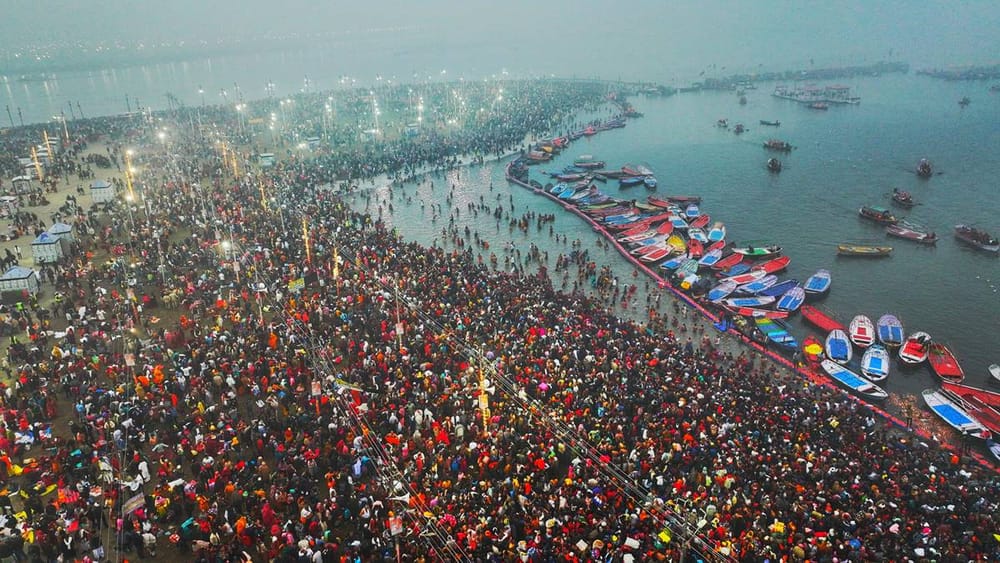
Every 12 years, this quiet riverbank transforms into the largest peaceful gathering of humans on the entire planet. Millions of pilgrims, ascetics (sadhas), and global travelers descend upon a massive, temporary tent city constructed directly on the dry riverbeds. The energy here during a major bathing date is electric, filled with smoke from holy fires, complex chanting, and deep spiritual devotion.
If you plan to visit during a Kumbh or Ardh Kumbh Mela, booking your stay months in advance is absolutely mandatory. Travelers frequently use platforms like SliceStay to find reliable accommodation options before the city fills up completely.
The Sacred Circuit: Iconic Temples and Spiritual Sites
Prayagraj is home to a deeply revered network of temples, each carrying unique legends that date back thousands of years.
1. Alop Shankari Devi Shakti Peeth Mandir
Located near the Sangam, this is one of the most unique Shakti Peethas in India. Unlike conventional temples, there is no stone idol of the deity here. Instead, devotees worship a wooden chariot or palquin over a small square platform. Legend says this is the exact spot where the last part of Goddess Sati's body vanished (alopa), making it a site of immense spiritual energy.
2. Shri Mankameshwar Mahadev Mandir
Situated right on the banks of the Yamuna River near the fort, this ancient temple is dedicated to Lord Shiva. It is believed that Goddess Sita stopped here to pray during her exile. The temple is especially crowded on Mondays and during Shravan, with devotees seeking the fulfillment of their deepest wishes (Mankamna).
3. Shri Nagvasuki Mandir
Perched on the banks of the Ganga in the Daraganj area, this unique temple is dedicated to Nag Vasuki, the king of serpents. It finds mention in the Puranas and is one of the very few places where a snake deity is worshipped in this form. Taking a dip in the Ganga nearby and visiting this temple is considered a powerful ritual, especially on Nag Panchami.
4. Shri Adi Shankar Vimana Mandapam
Located right near the Sangam nose, this towering, colorful 130-foot multi-tiered structure stands out prominently. Built by the Kanchi Kamakoti Peetham, it features beautiful South Indian architectural styles across four distinct floors, each dedicated to different deities including Goddess Kamakshi, Tirupati Balaji, and Lord Shiva.
5. ISKCON Prayagraj
For a peaceful, soul-stirring evening of bhajan and kirtan, head over to the ISKCON temple in the city. The beautiful deities, clean environment, and serene atmosphere make it a perfect spot to sit quietly and meditate after a long day of sightseeing.
6. Digambar Jain Temples
The city also holds immense significance for Jainism. Prayagraj is considered the birthplace of the eleventh Jain Tirthankara, Shreyansanatha. You can visit beautiful Digambar Jain temples in the city, known for their pristine marble work, quiet prayer halls, and peaceful ambiance.
Top Architectural and Historical Places to Visit
Beyond the riverbanks, Prayagraj houses an incredible array of architectural marvels from three distinct historical eras: Ancient, Mughal, and Colonial British.
1. Akbar’s Prayagraj Fort and the Akshaya Vat
Standing grandly at the edge of the Yamuna, this fort is the largest fortress ever built by Emperor Akbar. While large sections are currently controlled by the Indian Army and closed to the public, you can still visit the famous Patalpuri Temple—an underground temple network housing ancient shrines. Within this fort lies the sacred Akshaya Vat (the immortal banyan tree). According to local lore, this tree can survive any cosmic destruction, and visiting it has been a core pilgrimage ritual for thousands of years.
2. The Tragedy and Splendor of Khusro Bagh
Located close to the main railway station, Khusro Bagh is a grand, walled Mughal garden complex covering over 40 acres. It serves as a stark reminder of the brutal internal politics of the Mughal empire. The site houses three exquisite sandstone tombs of the family of Emperor Jahangir.
The largest tomb belongs to Khusro Mirza, Jahangir's eldest son, who rebelled against his father for the throne, was blinded as punishment, and later assassinated. Next to him lie the tombs of his mother, Shah Begum, and his sister, Nisar Begum. The tomb of Nisar Begum is architecturally the most stunning, featuring intricate plasterwork, painted ceilings, and beautiful structural proportions that rival the finest monuments in Agra. It is an incredibly peaceful escape from the chaotic city markets outside.
3. Anand Bhavan and Swaraj Bhavan
For a deep dive into modern history, visit the ancestral home of the Nehru family. Anand Bhavan is a beautiful, sprawling double story mansion that has been turned into a museum. It showcases the personal belongings, a massive library, and the preserved rooms of leaders like Motilal Nehru, Jawaharlal Nehru, and Indira Gandhi. Right next to it sits Swaraj Bhavan, the older family mansion that was donated to the Indian National Congress. This building served as the de facto headquarters of the independence movement during the 1920s and 30s, and it is where countless historic political resolutions were drafted.
4. All Saints Cathedral (Patthar Girja)
An absolute masterpiece of Gothic Revival architecture, this cathedral was designed by the famous British architect Sir William Emerson in the late 19th century (the same mind behind the Victoria Memorial in Kolkata). Built entirely of fine white stone and pale red sandstone, its soaring towers, gargoyles, and stunning stained-glass windows make it one of the most prominent colonial-era churches in North India.
5. The Mighty Allahabad High Court
Established in 1866, the Allahabad High Court is one of the oldest and largest high courts in India. The sprawling colonial building with its grand facades and classic arches represents the massive legal and administrative power the city held during the British Raj and continues to hold today as a pillar of Indian jurisprudence.
6. Historic Naini Central Jail
Located across the Yamuna River, Naini Central Jail is a site of deep historical weight. Built during the British colonial era, it held thousands of freedom fighters during the Indian Independence Movement, including Jawaharlal Nehru, Mahatma Gandhi, and Govind Ballabh Pant. It stands as a silent monument to the struggles and sacrifices made for the country's freedom.
7. The Mythological Ulta Qila (Jhunsi)
Located on the high mounds across the river in Jhunsi, the Ulta Qila (Overturned Fort) holds a fascinating place in local folklore. According to legend, this was the fort of King Haribong, a cruel ruler who was cursed by a holy saint, causing the entire fort to turn upside down overnight. Today, the archaeological site offers expansive, elevated views of the Ganga and the Sangam, making it a great offbeat spot for history buffs.
The Oxford of the East: Historic Educational Institutions
Prayagraj has long been celebrated as an intellectual capital. During the late 19th and early 20th centuries, it produced a massive share of India's top civil servants, writers, and politicians, earning the nickname "The Oxford of the East."
University of Allahabad and Muir Central College
Established in 1887, the University of Allahabad is the fourth oldest modern university in India. The crown jewel of the campus is Muir Central College, featuring breathtaking Indo-Saracenic architecture designed by William Emerson. The college features a striking 200 foot tall minaret tower made of local sandstone, vast arcades, and a beautiful dome decorated with blue and white tiles. Walking through this historic campus gives you a profound sense of the academic legacy that shaped modern India. If you are visiting the university for academic events or entrance exams, finding a quiet SliceStay property nearby ensures a stress-free trip.
Ewing Christian College (ECC)
Another stellar institution running along the banks of the Yamuna is ECC, founded in 1902. Known for its gorgeous green campus and old stone buildings, it has stood as a bastion of science and liberal arts education for over a century.
Local Food Guide: Famous Treats and Street Eats
Prayagraj is a paradise for street food lovers. The city's food culture leans heavily toward classic North Indian flavors, with a few iconic culinary legends you simply cannot miss.
- The Legendary Dehati Rasgulla: You cannot leave Prayagraj without crossing the bridge to Naini or visiting the iconic Dehati Rasgulla outlets. These large, dark-brown rasgullas are fried and soaked in rich, warm sugar syrup. They are incredibly soft, rich, and famous across the entire state.
- The Famous Prayagraji Amrud (Guavas): Prayagraj is nationally famous for its red-core guavas (Allahabadi Surkha). These guavas are apple-red on the outside and bright pink on the inside, offering an incredibly sweet, distinct flavor with a pinch of local chaat masala.
- Netram Mulchand Halwai (Katra): Go here for an authentic breakfast of hot, fluffy kachoris fried in pure desi ghee, served with a spicy potato curry and a side of sweet, thick curd. Be sure to book a central SliceStay so you can walk here early before the massive crowds arrive.
- Hari Ram & Sons (Loknath): Located deep in the narrow, winding lanes of the old city, this legendary shop is famous for its unique dry snacks like khasta and dalmoth.
- El Chico (Civil Lines): If you want a comfortable sit down dinner with a mix of continental, Chinese, and classic Indian dishes, this is the most reliable upscale restaurant in town.
Shopping Streets: Markets and Souvenirs
To truly experience the local pulse of the city, you have to explore its vibrant, historic commercial centers.
Chowk and Ghanta Ghar
Chowk is the beating heart of old Prayagraj. Dominated by the historic Ghanta Ghar (Clock Tower) built in 1913, this bustling market area is a sensory overload in the best way possible. The narrow lanes are lined with shops selling everything from traditional brass utensils and local spices to beautiful ethnic wear. It is the best place to find high-quality Chikankari embroidery work, intricate jewelry, and authentic local snacks. Navigating the crowds here is easier if you leave your heavy bags back at your secure SliceStay rental.
Civil Lines
If you prefer a more modern shopping experience, Civil Lines offers wide, organized avenues filled with branded showrooms, trendy cafes, and comfortable shopping complexes. It provides a stark, fascinating contrast to the ancient charm of the Chowk markets.
Practical Travel Information
Best Time to Visit
The best window to visit is between October and March. The weather during these months is pleasant and cool, making it easy to explore the outdoor monuments and spend hours by the ghats. Summers can be brutally hot, with temperatures easily soaring past 40 degrees Celsius, which makes midday sightseeing tough.
Getting Around the City
Auto rickshaws and e-rickshaws are the lifelines of local transport. They are easily available, eco-friendly, and highly affordable. For longer day trips to sites like Ulta Qila or out to the city edges, booking a private cab through your accommodation provider or a local rental service is recommended. Having a reliable base at a SliceStay makes organizing local travel much smoother.
Finding a Place to Stay
The city layout spreads across older cultural districts like Katra and Loknath and modern commercial areas like Civil Lines. Depending on your travel goals, choosing a central location saves hours of commuting time.
If you want shopping and modern restaurants, stay in Civil Lines. If you want quick access to the holy ghats, look for properties closer to the Sangam area. Be sure to check verified listings on SliceStay to lock down secure, comfortable properties that suit your budget.
An Expanded 3-Day Itinerary
To accommodate all these incredible spots, here is a perfectly balanced 3-day exploration layout:
Day 1: The Spiritual Core
- 6:00 AM: Morning boat ride at Triveni Sangam; see the confluence of the rivers at sunrise.
- 8:30 AM: Visit the multi-tiered Shri Adi Shankar Vimana Mandapam right near the ghats.
- 10:00 AM: Heavy breakfast at Netram Mulchand Halwai in Katra.
- 11:30 AM: Explore Akbar's Fort, Patalpuri underground temple, and the sacred Akshaya Vat.
- 3:30 PM: Visit the unique Alop Shankari Devi Shakti Peeth Mandir.
- 5:30 PM: Spend a serene evening at the iconic Shri Nagvasuki Mandir in Daraganj.
- 7:30 PM: Head back to your comfortable SliceStay to rest and recharge.
Day 2: Mughal Marvels and Old City Vibes
- 9:00 AM: Head out to explore the peaceful, vast orchards and grand sandstone tombs inside Khusro Bagh.
- 12:00 PM: Pay a visit to the ancient Shri Mankameshwar Mahadev Mandir on the Yamuna banks.
- 2:00 PM: Cross over to Naini to see the historic Naini Central Jail from the outside and indulge in the famous, warm Dehati Rasgullas.
- 4:30 PM: Cross back and head to Chowk and Ghanta Ghar for a vibrant evening of local shopping for Chikankari work and street food trailing at Loknath lane.
Day 3: Academia, Revolution, and Hidden Legends
- 9:30 AM: Visit Anand Bhavan and Swaraj Bhavan to immerse yourself in the history of India's independence struggle.
- 11:30 AM: Take a relaxing stroll through the historic, stunning campus of Allahabad University and photograph the Muir Central College tower.
- 1:30 PM: Drive out to the archaeological site of Ulta Qila in Jhunsi for an expansive view of the city rivers.
- 4:00 PM: Head to Civil Lines for a pleasant lunch at El Chico, view the grand architecture of the Allahabad High Court, and photograph All Saints Cathedral.
- 6:00 PM: Wind down your trip with a peaceful walk through Alfred Park (Chandra Shekhar Azad Park) and visit the tranquil ISKCON Prayagraj temple for evening prayers.
Prayagraj has a unique way of slowing you down. Between the wide river views, the chaotic charm of the old markets, and the deep layers of history, it is a place that invites you to stay a little longer and absorb the local rhythm. Ready to make the journey? Plan ahead, secure your bookings through SliceStay, and dive straight into the heart of Uttar Pradesh.